

Winter has a way of turning the world silent. Lakes harden into glass, forests hold their breath, and every step across the snow feels like a promise made to the cold. On one such winter morning, a lone man walked the edge of a frozen lake, unaware that the quiet around him was about to break into a moment that would test both fear and kindness.
The lake looked solid, sealed by weeks of subzero nights. Wind had brushed the snow into thin drifts, revealing patches of clear ice that reflected the pale sky. The man—an experienced outdoorsman, accustomed to reading the land—was checking animal tracks along the shoreline. Deer had passed through earlier that morning. Fox, too. Then he noticed something wrong.
Near the center of the lake was a dark, irregular shape. At first, he thought it was a shadow or a fallen branch trapped beneath the surface. Then it moved.
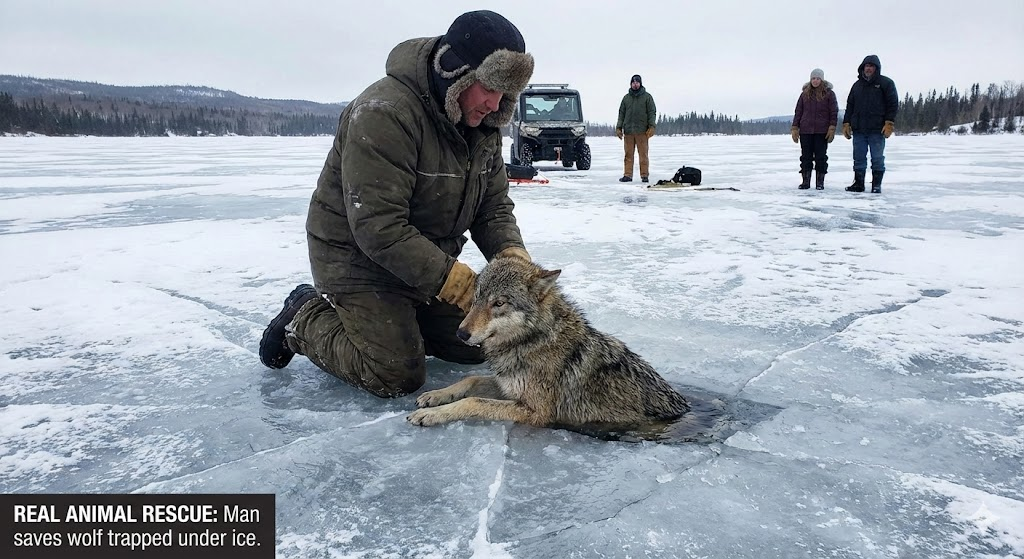
A low, desperate sound carried across the ice—muffled, strained, unmistakably alive. The man’s heart dropped. He knelt and focused, and there it was: a wolf, partially submerged, its powerful body pinned beneath a fractured sheet of ice. The animal had likely chased prey across the frozen surface when the ice gave way. Now it was trapped in freezing water, exhaustion already stealing its strength.
The wolf thrashed weakly, claws scraping uselessly against the slick ice. Each movement risked pulling it farther under. Its eyes—sharp even in panic—locked onto the man. There was fear there, yes, but also something else: a raw, animal plea that crossed the boundary between species.
The man knew the danger immediately. Ice rescue is unforgiving. One wrong step, and he would join the wolf in the water. But turning away was not an option he could live with.
He lay flat on his stomach to spread his weight, inching forward across the ice. The cold bit through his gloves, through his jacket, into his bones. Every crack echoed like a warning shot. He stopped often, testing the surface, breathing slowly to keep his hands steady.
When he reached the edge of the broken ice, the reality hit him hard. The wolf was heavier than he expected—thick winter coat soaked, muscles trembling from cold and fatigue. The animal snapped once, more from terror than aggression, then went still, too tired to fight.
Speaking softly, the man grabbed the wolf by the scruff and under its forelegs, careful to keep distance from its jaws. He braced himself, dug his boots into the ice behind him, and pulled.
Nothing happened.
The wolf slipped back, water swallowing its chest again. The man adjusted his grip, ignoring the pain blooming in his arms, and tried once more. This time, the ice cracked louder, splintering outward like a spiderweb. Fear surged—but he didn’t let go.
With a final, desperate effort, he dragged the wolf free of the hole. The animal collapsed onto the ice, chest heaving, body shuddering violently as icy water streamed from its fur. For a moment, neither of them moved. Man and wolf lay side by side on the frozen lake, bound by exhaustion and shock.
Slowly, the wolf found its footing. It staggered back, slipping once, then standing tall despite the cold and fatigue. The man backed away carefully, giving the animal space. He expected the wolf to flee immediately.
Instead, the wolf paused.
It turned its head and looked at him—really looked—eyes clear now, alert, alive. There was no growl, no snarl. Just stillness. Then, as if the moment had said all it needed to say, the wolf turned and limped toward the forest, disappearing into the trees where the winter swallowed it whole.
The man stayed there long after, watching the empty treeline, listening to the lake settle back into silence. His clothes were soaked, his hands numb, his heart racing. But he felt something rare and steady beneath it all: the quiet certainty that, for once, fear had not won.
Stories like this don’t make the cold less dangerous or the wild less wild. Wolves remain powerful, unpredictable, and deserving of distance and respect. Ice remains thin, winter remains ruthless. But sometimes, in a narrow space between danger and mercy, a choice is made that reminds us what humanity looks like at its best.
No cameras. No audience. Just one person, one animal, and a frozen lake that briefly held a story worth telling.